I-490 + IL 390: The Western O’Hare Connection That Will Reshape Chicagoland Industrial
For years, the story around the Elgin O’Hare Western Access program has been told as an “airport access” project for commuters and travelers alike. The new I-490/IL 390 interchange is designed to provide full western access to and from O’Hare International Airport.
But that’s only half the impact.
The bigger long-term shift is what happens around the airport: the industrial parks in Elk Grove Village, Wood Dale, Bensenville, Itasca, and the broader O’Hare logistics ring gain a faster, more direct link into the interstate system, specifically I-90 and I-294, without forcing trucks traffic through as many local-road compromises.
If you care about freight movement, distribution efficiency, and why industrial real estate clusters are where they are, this is one of the most consequential transportation rewires in Chicagoland in decades.
So what new infrastructure is being built?
At the center of the western access buildout is the I-490/IL 390 Interchange Project, a new full-access interchange that connects:
Illinois Route 390 Tollway (east–west)
The new I-490 Tollway (north–south, along O’Hare’s western edge)
Key local connectors like York Road and Irving Park Road (IL 19)
And critically: direct ramps into/out of O’Hare’s west side for industrial traffic
The Illinois Tollway describes the interchange scope as:
$534 million
3 miles of I-490 mainline roadway
16 ramps
15 bridges
Scheduled for completion by the end of 2027
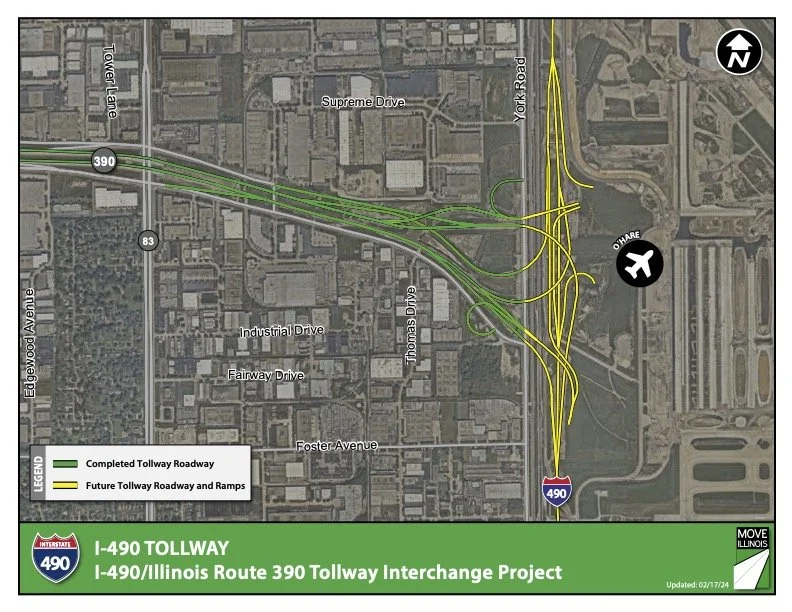
For a Birdseye “where is all this happening?” visual: the interchange area sits tightly around the York Road corridor and the west edge of O’Hare, with ramps threading through an already dense industrial street grid (Foster Avenue, Edgewood Avenue, Industrial Drive, and others). Our properties at 384 Beinoris and 537 N. Edgewood Ave, both located in Wood Dale, IL, will benefit directly from this new infrastructure investment and access to the national interstate grid.
Why this is more than an airport project
The Tollway’s own framing around the project is revealing: the IL 390 + I-490 investment isn’t just about passengers. It’s about linking businesses and communities to one of the nation’s busiest airports, plus freight transportation hubs, distribution centers, and major interstate corridors, including I-90 and I-294.
When a region with that much existing industrial development gets a new piece of high-capacity, interstate-grade connective tissue, the ripple effects show up in:
Travel time reliability
Driver route simplicity
Labor access
Tenant willingness to pay for “minutes saved”
And ultimately, industrial competitiveness in a national distribution network
The industrial trip upgrade: IL 390 meets I-490, and the map changes
Here’s the freight/industrial “aha”:
IL 390 functions as a key east–west corridor in the O’Hare area network.
I-490 functions as a new north–south spine along the airport’s western border, connecting toward the region’s major interstates.
When those two meet at a full-access interchange—built with flyover ramps and direct connections at I/90—the industrial areas around O’Hare gain something extremely valuable:
1) Easier access to I-90 and I-294
The Tollway and Move Illinois plan explicitly positions the program as linking to I-90 (Jane Addams) and I-294 (Tri-State).
In practical industrial terms, that means:
North/Wisconsin-bound distribution and supplier trips can route more cleanly via I-90.
South/Indiana-bound and broader interstate connections (including I-80 access via the Tri-State structure) can become simpler via I-294.
Trips that previously relied on a patchwork of arterials can shift to higher-capacity roadways faster.
2) More direct “eastbound” logic for industrial trips
Trips heading east become more direct and less time-consuming.
That’s the network effect: once the IL 390/I-490 connection is fully functional, “getting to the interstate grid” becomes less of a zig-zag. Less weaving through local roads means:
fewer signalized intersections,
fewer low-speed bottlenecks,
fewer routing compromises during peak congestion.
3) A better outcome for the communities that already do the work
Elk Grove Village, Wood Dale, and the broader O’Hare industrial ring already contain a massive concentration of logistics, manufacturing, and data center infrastructure.
So the benefit isn’t “maybe we’ll get industry.” It’s “we’re investing to make the existing industry operate with less friction.”
What published forecasts say about travel time savings (and why it matters)
It’s tempting to promise “X minutes saved” for every trip. Real life is messier: time savings vary by origin/destination, time of day, incident traffic, and how quickly drivers and fleets adjust routing.
But we do have credible corridor-level estimates from official and federal materials.
A Tollway overview factsheet projected that the broader program would reduce travel time by more than seven minutes on the 11-mile trip between the west side of O’Hare and Lake Street (US 20)—roughly 20–25% depending on the document version.
Those same sources projected additional corridor-scale benefits by 2040, such as:
>16% less traffic on local roads during rush hour
24% reduction in delays on local roads
and roughly $145 million per year in time and fuel savings
For industrial users, those “benefits” matter because they translate into:
fewer late pickups,
tighter delivery windows,
better driver utilization,
and more dependable travel times for both employees and shipments.
Why connectivity upgrades tend to matter for industrial real estate
Industrial space competes on a short list of fundamentals:
access to labor,
access to customers,
access to transportation,
and operating efficiency.
The O’Hare area already wins on transportation. What IL 390 and I-490 do is strengthen the next layer of that advantage: how quickly you can move from the industrial parks into the interstate network—and how consistently you can do it.
That consistency is what logistics tenants notice.
It can also widen the “tenant radius” for certain buildings:
A company that needs frequent interstate runs may value a building differently once the routing becomes simpler and more predictable.
A business that ships regionally may treat a few minutes of daily reliability as meaningful dollars over a year.
None of this is magic. It’s just what happens when a major freight-and-airport region reduces transportation friction.
Bottom line
The I-490 / IL 390 program is rightly discussed as a western access solution for O’Hare.
But the deeper story is the “industrial flywheel” around the airport: the new connection upgrades how one of the country’s densest industrial ecosystems plugs into I-90 and I-294—and that changes the logic of airport trips and freight trips at the same time. Illinois Tollway+2Illinois Tollway+2
If you operate in (or invest near) Elk Grove Village, Wood Dale, Elmhurst, or the broader O’Hare industrial ring, this is the kind of infrastructure that will materially improve daily logistics.